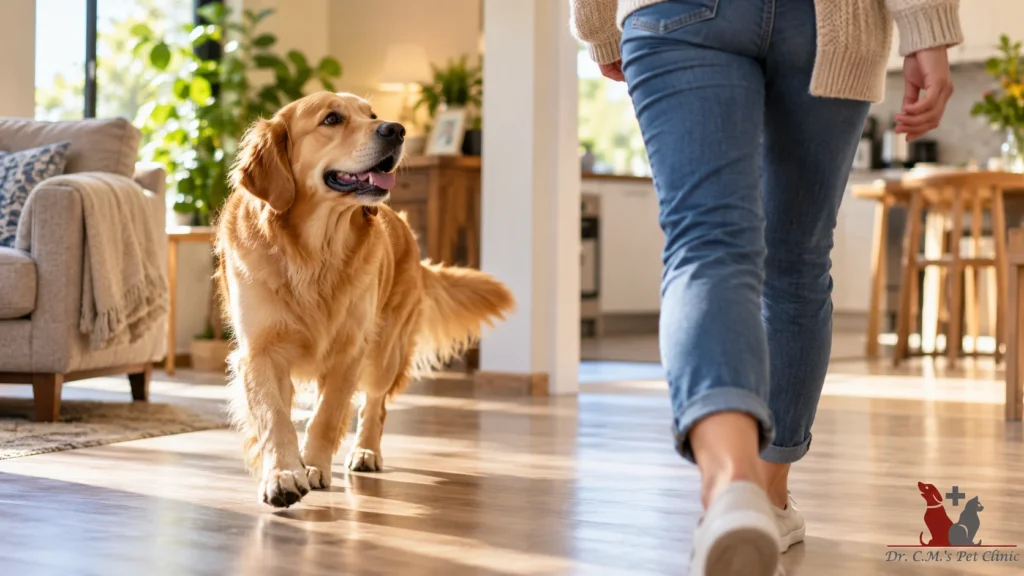
Your dog gets up when you get up, follows you from room to room, and somehow knows when you’re heading toward the kitchen—even when you haven’t made a sound. Close the bathroom door, and there may be a familiar pair of paws waiting on the other side.
For many dogs, staying close to their favourite person is simply part of everyday life. But the reason isn’t always affection alone. Your dog may be seeking companionship, anticipating something rewarding, responding to your routine, or looking for reassurance. The important distinction is whether following you is a comfortable habit or a new behaviour that suggests something has changed.
Understanding why your dog stays close can help you respond in a way that supports both your relationship and your dog’s independence.
Why your dog wants to be near you
1. You are a source of security and companionship
Dogs are social animals, and many form strong attachments to the people who care for them. Your presence can provide familiarity, reassurance and opportunities for interaction.
Your dog may choose to lie beside your desk while you work, follow you into another room, or settle nearby even when nothing particularly exciting is happening. These behaviours can reflect a preference for social contact rather than a problem that needs correcting.
However, following you everywhere doesn’t prove that your dog loves you more than other family members, nor does it reveal exactly what your dog is feeling. Individual temperament, past experiences and daily routines all influence how closely a dog stays to its people.
2. Your dog has learned that following you pays off
Consider what usually happens when you stand up.
You might head to the kitchen, pick up a lead, open the back door or reach for a favourite toy. From your dog’s perspective, your movements often predict something interesting.
Over time, following you can become a rewarding habit. Even small interactions—talking to your dog, offering a pat or making eye contact—may reinforce it.
This is one reason dogs sometimes appear to follow their owners without an obvious purpose. They may have learned that staying nearby is a useful way to find out what happens next.
It doesn’t necessarily mean your dog is hungry, bored or anxious. Sometimes, it is simply a behaviour that has worked well in the past.
3. Your dog knows your daily routine
Dogs are remarkably good at picking up patterns. The sound of a cupboard opening, the time you usually take a walk, or the sight of you putting on shoes can become a cue that something is about to happen.
Your dog may follow you because it has learned to anticipate these events. A dog that suddenly appears whenever you approach the front door might be hoping for a walk, while one that trails you toward the kitchen may associate that room with meals or treats.
This kind of following is often predictable and relaxed. Your dog is responding to familiar cues rather than necessarily experiencing distress.
4. Your dog may need more activity or mental stimulation
Some dogs follow their owners because the household offers more interesting things to investigate than their resting place does.
If your dog spends much of the day with little opportunity to explore, sniff, play or solve simple problems, your movements may become a welcome source of stimulation. Following you gives the dog something to do, even if you’re only folding laundry.
That doesn’t mean every dog that follows its owner needs more exercise. Some dogs simply enjoy company. But if following is accompanied by persistent restlessness, attention-seeking or difficulty settling, consider whether the dog’s daily routine provides enough suitable physical activity and mental enrichment.
Age, health, breed tendencies and individual temperament all affect what an appropriate activity level looks like.
5. Your dog may be looking for reassurance
Dogs sometimes stay close when their surroundings feel uncertain. A loud storm, fireworks, unfamiliar visitors, a change of home or an altered household routine can make a normally independent dog seek more contact.
In these situations, following you may be one way your dog responds to uncertainty. The behaviour alone, however, cannot establish that your dog is frightened or anxious. Look at the wider picture: a tense body, trembling, panting when it isn’t hot, repeated pacing or difficulty settling may provide additional clues.
If your dog seeks comfort during a frightening event, you don’t need to push it away to prevent dependency. Offer calm reassurance and, when possible, a quiet place where it can feel secure.
6. Your puppy is still learning about the world
Puppies often follow people closely because their surroundings are new and their confidence is still developing. Staying near a familiar caregiver can make exploration feel safer.
A puppy may trail you while learning household routines, watch what you do, or settle more easily when you are nearby. As it gains experience and confidence, its behaviour may change.
Rather than expecting a young dog to be independent immediately, introduce short, positive opportunities to rest in its own bed, explore appropriate toys and spend time at a comfortable distance from you. Independence is a skill that can be developed gradually.
7. Your older dog may be responding to a change in health
A senior dog that has always followed you may simply be maintaining a familiar habit. A dog that becomes unusually clingy later in life deserves closer attention.
Changes in vision or hearing can make the environment harder to navigate. Pain or reduced mobility may affect how confidently a dog moves around. Other age-related changes can also alter sleep, awareness and behaviour.
If an older dog suddenly begins following you much more closely, arrange a veterinary assessment, particularly if you also notice changes in appetite, movement, sleep, toileting or responsiveness. New clinginess isn’t proof of illness, but it shouldn’t automatically be dismissed as a normal part of ageing.
Does following you everywhere mean your dog has separation anxiety?
Not necessarily. This is one of the most important distinctions to understand.
A dog can prefer your company, follow you between rooms and still feel perfectly comfortable when you leave home. Separation anxiety is different: the dog experiences significant distress when separated from an attachment figure.
Signs can include persistent barking or howling, pacing, attempts to escape, destructive behaviour, drooling or toileting indoors while alone. Some dogs begin showing distress as they notice the usual signs that their owner is preparing to leave.
How to tell the difference
A dog that enjoys your company: Follows you around but can relax elsewhere, enjoy a toy, sleep alone for a while or remain settled when you go out.
A dog that struggles with separation: Becomes distressed when you leave or are out of reach, with persistent vocalisation, pacing, escape attempts or other signs of anxiety.
These patterns are useful clues, not a diagnosis. A veterinarian can help assess the behaviour and rule out other explanations. If you suspect separation anxiety, a video recording of your dog while you’re away can help reveal what happens after the door closes.
Punishing your dog for destructive behaviour or forcing it to endure prolonged distress is not an appropriate solution. A tailored behaviour plan, sometimes involving a veterinary behaviour professional and medication where indicated, may be needed.
Why does your dog follow you into the bathroom?
The bathroom is a particularly familiar example of this behaviour, but there isn’t one proven explanation that applies to every dog.
Your dog might simply want to remain near you. It may be curious about a room you have entered, accustomed to accompanying you everywhere, or interested in the possibility of attention.
The closed door itself may also be unusual if your dog normally has free access to you. Some dogs wait outside quietly; others scratch at the door or whine. What matters is the intensity of the reaction and whether the dog can settle when you are unavailable.
If your dog waits calmly outside, there’s usually little reason to be concerned. If it becomes frantic whenever a door separates you, consider whether the same distress appears in other situations involving separation.
What should you do if your dog follows you constantly?
If the behaviour is relaxed and doesn’t interfere with daily life, you may not need to change anything. There’s nothing inherently unhealthy about a dog enjoying your company.
If you’d like your dog to become more comfortable spending time independently, focus on making that experience rewarding rather than treating closeness as bad behaviour.
- Reward calm independence. When your dog settles on its bed or relaxes a short distance away, occasionally reward that calm behaviour with praise or a small treat.
- Provide appropriate enrichment. Offer suitable toys, sniffing opportunities and food puzzles when you can supervise them safely. Choose activities appropriate for your dog’s age, chewing habits and health.
- Practise brief separations gradually. Start with a distance or duration your dog can comfortably manage. Increase it in small steps, and return to an easier level if signs of distress appear.
- Keep routines predictable. Consistent opportunities for walks, play, rest and interaction can make the day easier for your dog to anticipate.
- Avoid punishment. Scolding, frightening or forcibly isolating a distressed dog can make the situation harder rather than teaching genuine independence.
- Seek help when necessary. If your dog panics when you leave, cannot settle or has developed a sudden change in behaviour, speak with your veterinarian before assuming that training alone will resolve it.
The goal isn’t to make your dog less attached to you. It’s to help your dog feel comfortable whether you’re sitting beside it or briefly occupied elsewhere. Gradual, reward-based training is preferable to abruptly demanding long periods of separation.
When should you be concerned about clinginess?
The most useful clue is often not how closely your dog follows you, but whether the behaviour has changed.
| What you notice | A sensible next step |
|---|---|
| Your dog has always followed you and remains relaxed when alone | Usually no intervention is needed if the behaviour is safe and manageable. |
| Your dog follows you more after a household change or frightening event | Look for other signs of distress and provide a predictable, secure environment. |
| Your dog panics, vocalises persistently or tries to escape when you leave | Arrange a veterinary assessment for possible separation-related distress. |
| Your dog suddenly becomes clingy, particularly in old age | Book a veterinary examination to investigate possible pain, sensory changes or other illness. |
| Clinginess occurs with marked lethargy, difficulty breathing, collapse or other severe symptoms | Seek urgent or emergency veterinary care as appropriate. |
A sudden behavioural change is not automatically a medical emergency, but accompanying physical symptoms and the severity of the change matter. When in doubt, contact your veterinary practice for advice on how quickly your dog should be examined.
The real meaning behind your dog’s constant companionship
A dog that follows you from room to room isn’t necessarily needy, anxious or unusually dependent. It may simply enjoy being close to you, have learned to anticipate your routine, or find your company reassuring.
The more useful question is whether your dog can also feel safe and relaxed when you aren’t immediately available. A dog that chooses to stay close but can comfortably settle elsewhere is in a different situation from one that panics whenever you leave.
Enjoy the companionship if it works for both of you. If the behaviour suddenly changes or begins interfering with your dog’s ability to relax, look beyond the habit itself and consider what might be driving it. Understanding that difference is a better starting point than trying to stop your dog from following you altogether.
Veterinary sources consulted
The article’s key behavioural distinctions and recommendations were developed with reference to these veterinary and pet-health resources:
- Merck Veterinary Manual — Behavior Problems of Dogs. Guidance on separation-related distress and its behavioural signs. Read the veterinary reference.
- Cornell University College of Veterinary Medicine — Anxious behavior: How to help your dog cope with unsettling situations. Information on canine anxiety and separation-related behaviour. Read the veterinary guidance.
- PetMD — Why Does My Dog Follow Me Everywhere? Veterinary-authored discussion of attachment, learned behaviour, routine, and potential health concerns. Read the article.
- American Animal Hospital Association (AAHA) — Separation Anxiety in Pets: Signs, Causes, and Solutions. Overview of separation-related distress and its signs. Read the guidance.

Dr. Chaitanya Solanki is a licensed veterinarian with over 10 years of hands-on clinical experience in companion animal medicine. As the founder of Dr. C.M.’s Pet Clinic, he has treated thousands of dogs and cats, focusing on preventive care, behavior, nutrition, and early disease detection. His writing is evidence-based, clinically informed, and designed to help pet owners make confident, responsible care decisions.