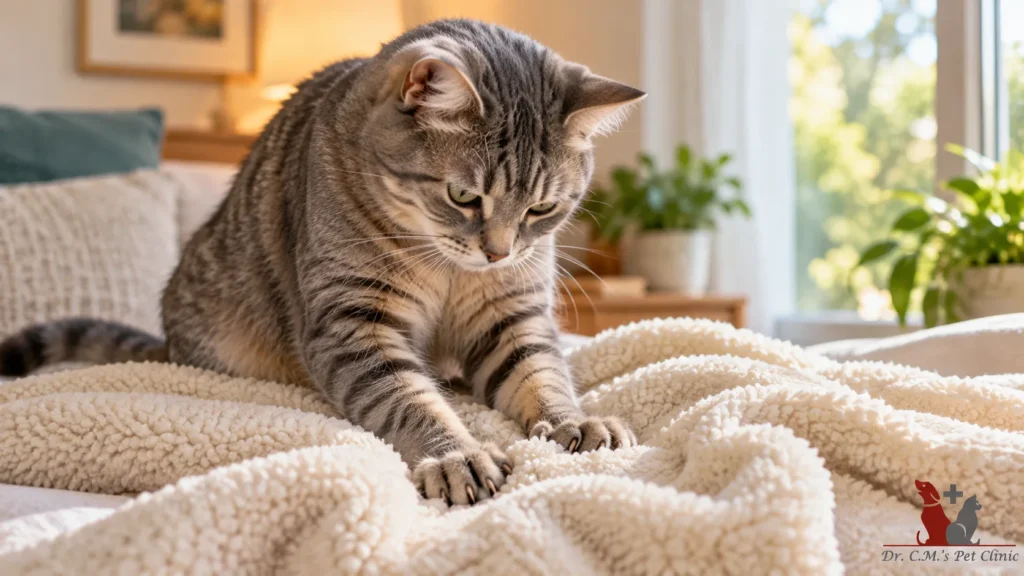
A cat finds a soft blanket, climbs onto it, and begins pressing one front paw down, then the other. The rhythm slows. The claws appear and disappear. Sometimes there’s a rumbling purr, half-closed eyes, and a look of complete concentration—as though the cat has an important job to finish before settling down.
Cat owners often call this behaviour “making biscuits.” It can look amusing, but the movement has roots in kittenhood, and its meaning in adult cats is more complicated than it first appears.
Kneading is a normal feline behaviour that often occurs when cats are relaxed or preparing to rest. It begins during nursing, when kittens press their paws against their mother’s mammary area to help stimulate milk flow. Why some cats continue kneading throughout adulthood is less certain. Comfort, familiar associations and other possible functions may all play a part.
Understanding the difference between what researchers know and what they can only reasonably suggest makes this familiar behaviour even more interesting.
What exactly is a cat doing when it kneads?
Kneading is a repeated, alternating movement in which a cat presses its front paws into a surface, often extending and retracting its claws as it goes. The surface might be a fleece blanket, a cushion, a duvet, a favourite person’s lap or even another pet.
Not every cat kneads in the same way. Some use both paws in a slow, deliberate rhythm; others press more vigorously or add purring, drooling or gentle sucking on the fabric.
The movement is usually harmless, and many cats continue it long after kittenhood. However, not all cats knead, and the behaviour can vary considerably between individuals.
The key is to understand what the behaviour might accomplish without assuming that every cat has the same reason for doing it.
Why cats knead blankets and other soft surfaces
1. The behaviour begins with nursing
The clearest explanation for where kneading originates is early kittenhood.
When kittens nurse, they rhythmically press their paws against their mother’s mammary area. This action helps stimulate milk flow while they feed. It happens in a setting associated with warmth, nourishment and close physical contact.
Adult cats no longer need to knead to obtain milk, yet many continue the movement. One plausible explanation is that a behaviour established during nursing becomes associated with comfort and is repeated in similarly soothing situations later in life.
A soft blanket may provide the kind of texture that makes this familiar movement easy and satisfying.
That doesn’t mean an adult cat literally believes it is nursing again. The connection between early experience and adult kneading is a reasonable behavioural explanation, but the precise reason the habit persists in individual cats isn’t fully established.
2. Kneading may help a cat settle and relax
Watch when your cat chooses to knead. It may happen just before a nap, while curling up beside you, or after finding a particularly soft patch of bedding.
In these situations, kneading often accompanies relaxed body language. The cat may purr, soften its posture or eventually lie down.
This pattern supports the idea that kneading can be a comforting activity. It may be part of a familiar sequence that helps a cat settle into a resting place.
Still, purring and kneading don’t provide a perfect reading of a cat’s emotional state. Cats can purr in more than one context, and a single behaviour rarely tells the whole story. Look at the cat’s posture, surroundings and usual habits as well.
3. Your cat may be preparing a comfortable resting spot
Another proposed explanation connects kneading with the way cats interact with bedding before resting.
Domestic cats sometimes press and rearrange blankets before lying down. The movement may be related to an instinct to manipulate a resting surface, although it has not been established that every modern cat kneads for this purpose.
If your cat kneads a duvet for several seconds, turns around and then curls up for a nap, preparing a comfortable spot is a plausible interpretation.
There’s no need to assume your cat is deliberately recreating a wild ancestor’s behaviour. The observation is simpler: kneading often occurs around resting, and adjusting a soft surface may be part of that routine.
4. Kneading may leave a familiar scent
Cats have scent glands in their paws. When they press their feet against a blanket or another surface, they may leave scent cues behind.
This makes scent marking another plausible part of kneading. A cat repeatedly using the same cushion or blanket may be interacting with a familiar, frequently used resting place, potentially reinforcing its own scent there.
It’s tempting to interpret this as your cat declaring that a blanket—or you—belongs exclusively to it. That’s more certainty than the evidence warrants. Scent marking is part of feline communication, but kneading can have several overlapping explanations, and the movement alone cannot tell you which one matters most to your cat.
5. Some cats knead while seeking comfort
Kneading isn’t always a sign that everything is perfect. Repetitive behaviours can sometimes help animals cope with tension, and some cats may knead more when unsettled.
Context matters. A cat that routinely kneads its favourite blanket before sleeping, with a relaxed body and otherwise normal behaviour, is different from one that begins kneading persistently after a move, a change in household routine or the arrival of another animal.
Even then, kneading by itself does not establish that a cat is stressed. Look for the wider pattern, including changes in hiding, appetite, interaction, grooming or litter-box habits. If the behaviour changes noticeably or accompanies other concerning signs, a veterinary assessment is appropriate.
Why does your cat knead a blanket and then suck on it?
Some cats combine kneading with sucking, licking or gently chewing a blanket. This can resemble the movements associated with nursing, and the behaviours may be connected for some individuals.
Occasional sucking on a soft fabric isn’t necessarily a medical problem. However, chewing or swallowing fabric is a different concern from simply kneading it. Ingested material can cause serious digestive complications, including an intestinal blockage.
If your cat repeatedly eats pieces of blankets, clothing or other non-food materials, contact your veterinarian. Seek prompt veterinary advice if you suspect your cat has swallowed fabric, particularly if vomiting, reduced appetite, abdominal discomfort or difficulty passing stool develops. Do not pull a piece of string or fabric protruding from the mouth or anus.
For a cat that only suckles a blanket, choose a safe, intact fabric and supervise the behaviour if there is any risk of chewing off pieces. If the sucking is new, escalating or difficult to interrupt, discuss it with your veterinarian.
Why does your cat knead you instead of a blanket?
When a cat kneads your lap, it may be choosing a warm, soft place where it feels comfortable. Your familiar scent and the opportunity for close contact may also make your lap appealing.
Many cats knead while purring or settling down beside a person they know well. It can fit with a relaxed social interaction, but it isn’t a guaranteed declaration of affection. Cats have individual preferences, and the same behaviour can occur in different contexts.
If the claws hurt, place a thick blanket between your cat’s paws and your skin. You can also gently guide your cat onto a nearby cushion rather than pushing it away abruptly. Keep the cat’s nails appropriately trimmed if you can do so safely, or ask a veterinary professional for help.
You don’t have to endure painful kneading to preserve your bond with your cat. A comfortable alternative allows the behaviour to continue without injuring you or damaging your clothing.
Should you stop your cat from kneading?
Usually, no. Kneading is a normal feline behaviour, and there is generally no reason to prevent a relaxed cat from doing it.
If your cat is damaging furniture or catching its claws in delicate fabrics, redirect the behaviour to a suitable surface instead.
- Offer a dedicated blanket. Choose a thick, washable blanket that is comfortable to knead and doesn’t shed pieces your cat could swallow.
- Make the alternative appealing. Place it in a quiet resting spot your cat already enjoys.
- Protect your lap. Keep a soft cushion or blanket nearby if your cat likes kneading while sitting with you.
- Maintain nail care. Regular, appropriate nail trimming can reduce snagging and accidental scratches.
- Avoid punishment. Shouting, spraying water or physically frightening your cat won’t explain what you want it to do instead. Calm redirection is a better approach.
These steps are consistent with the American Animal Hospital Association’s guidance on allowing normal kneading while providing appropriate outlets when claws or furniture become a problem.
When is cat kneading a reason to see a vet?
The frequency of kneading varies from one cat to another. Some knead almost every day, while others rarely do it. Neither pattern automatically indicates a problem.
Pay attention to a meaningful change from your cat’s normal behaviour, rather than counting how many times it kneads.
| What you notice | What to do |
|---|---|
| Your cat kneads its usual blanket before resting | Generally normal; no intervention is needed if the cat is otherwise well. |
| Your cat starts kneading more often after a household change | Look for other signs of stress and arrange veterinary advice if the change persists or concerns you. |
| Your cat appears uncomfortable, limps or reacts painfully when kneading | Arrange a veterinary assessment. |
| Your cat chews and swallows blanket fibres | Contact your veterinarian because swallowed fabric can cause a digestive obstruction. |
| Your cat’s kneading changes alongside reduced appetite, hiding or other unusual behaviour | Arrange a veterinary examination to investigate the change. |
A sudden increase or decrease in kneading does not identify a particular illness. It is one piece of information that a veterinarian can consider alongside your cat’s other signs and medical history.
What those little paw movements really tell you
A cat kneading a blanket is displaying a behaviour with a clear beginning in kittenhood, but its adult purpose isn’t completely understood. Comfort, familiar associations, resting routines and scent marking are all plausible parts of the explanation.
The most useful thing you can do is pay attention to the circumstances. If your cat chooses a soft blanket, kneads for a while and settles down comfortably, there is usually no need to intervene. If the behaviour changes dramatically or involves chewing and swallowing fabric, take it more seriously.
You don’t need to decode every paw movement to understand your cat. Sometimes the best response is simply to provide a safe, comfortable place to knead—and let your cat decide when it’s time to settle in.
Sources
1. American Animal Hospital Association (AAHA) — Why Do Cats Knead? Covers the nursing origins of kneading, possible explanations in adult cats, scent marking, and appropriate redirection. Read the veterinary guidance.
2. Cats Protection — Why do cats knead? Explains kitten nursing behaviour and discusses the uncertainty around why adult cats continue kneading. Read the feline behaviour resource.
3. PetMD — Why Do Cats Knead? Veterinary-authored information on kneading, comfort, blanket behaviour and situations in which a change may warrant veterinary attention. Read the article.

Dr. Chaitanya Solanki is a licensed veterinarian with over 10 years of hands-on clinical experience in companion animal medicine. As the founder of Dr. C.M.’s Pet Clinic, he has treated thousands of dogs and cats, focusing on preventive care, behavior, nutrition, and early disease detection. His writing is evidence-based, clinically informed, and designed to help pet owners make confident, responsible care decisions.