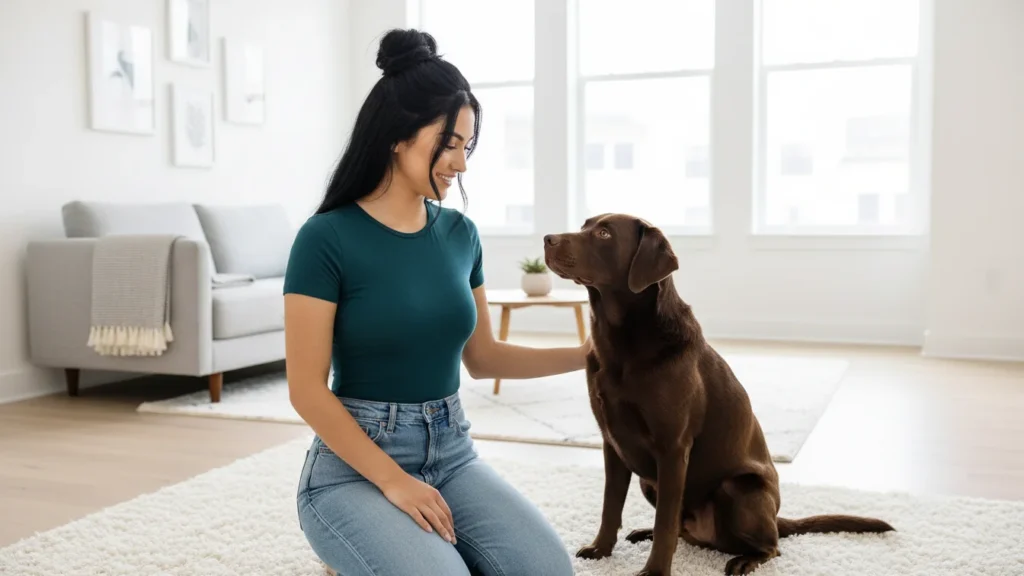
A Quiet Moment Every Dog Owner Knows
You’re sitting on the couch.
Your phone is in your hand.
The room is calm.
And then you feel it.
You look up—and your dog is staring at you.
Not glancing.
Not blinking.
Just… watching.
It can feel loving.
Confusing.
Sometimes unsettling.
Many pet parents ask the same question in clinics and consultations:
“Why does my dog stare at me like that?”
This article explains what that unblinking gaze truly means—through canine psychology, biology, and real-world behavior—so you can respond with clarity instead of worry.
Why This Behavior Feels So Intense to Humans
Humans interpret eye contact emotionally.
In our social world, prolonged staring can mean:
- Deep attention
- Emotional connection
- Confrontation or threat
So when a dog holds eye contact, our brain searches for meaning.
But dogs don’t use eye contact the way humans do.
Their stare isn’t accidental—and it isn’t random—but its meaning depends heavily on context, relationship, and body language.
Understanding that difference is the key to decoding the message behind the gaze.
The Evolutionary Reason Dogs Use Eye Contact
Dogs evolved alongside humans—not just near us, but with us.
Research on canine cognition shows that dogs are uniquely skilled at reading:
- Human facial expressions
- Eye direction
- Emotional tone
Unlike wolves, dogs learned that looking at humans brings information.
Food.
Guidance.
Safety.
Connection.
Eye contact became a communication bridge.
That’s why dogs stare—not because they’re dominant or plotting—but because they’re wired to observe you.
The Most Common Reasons Dogs Stare Without Blinking
1. They’re Communicating a Need (Without Knowing Words)
Dogs often stare when they want something but don’t know how else to ask.
Common needs include:
- Food or treats
- Going outside
- Playtime
- Attention or reassurance
The stare is a polite request.
Many dogs learn that eye contact works because humans eventually respond.
👉 If the stare happens around the same time daily, it’s often need-based—not emotional.
2. They’re Reading You Emotionally
Dogs are exceptionally sensitive to human emotional states.
- Facial tension
- Eye movement
- Posture
- Breathing rhythm
When you’re stressed, sad, distracted, or excited, your dog may stare longer to interpret what’s happening.
This is especially common in dogs strongly bonded to their owners.
Eye contact helps them decide:
- Should I approach?
- Should I stay calm?
- Should I give space?
3. Eye Contact Releases Bonding Hormones
Here’s a fascinating biological insight.
Studies show that mutual gazing between dogs and humans increases oxytocin levels in both—often called the “bonding hormone.”
Oxytocin strengthens:
- Trust
- Attachment
- Emotional safety
This is the same hormone involved in parent-child bonding.
In calm, relaxed situations, your dog’s unblinking stare may simply be love.
When Staring Is a Sign of Deep Trust
In the canine world, direct eye contact can be risky.
Among unfamiliar dogs, prolonged staring may signal challenge or tension.
So when your dog stares at you calmly, it often means:
- They feel safe
- They trust you
- They don’t perceive you as a threat
A relaxed stare paired with:
- Soft eyes
- Loose body
- Neutral ears
is a powerful sign of emotional security.
When a Dog’s Stare Means Something Else
Not all staring is the same.
Here’s where context matters.
Red Flags to Watch For
A stare may signal discomfort or anxiety if paired with:
- Stiff body posture
- Frozen stillness
- Growling or lip tension
- Whale eye (white of eyes showing)
In these cases, the stare isn’t affection—it’s communication of unease.
This is your dog saying:
“I’m overwhelmed. Please notice.”
Ignoring this can escalate stress.
Staring vs Normal Dog Attention: A Clear Comparison
| Type of Stare | Body Language | Likely Meaning | What to Do |
|---|---|---|---|
| Soft, relaxed | Loose body, blinking | Bonding, affection | Respond calmly |
| Expectant | Sitting near you | Wants something | Check routine needs |
| Intense, stiff | Frozen posture | Stress or fear | Give space |
| Repetitive | Happens daily | Learned behavior | Adjust reinforcement |
Common Mistakes Owners Make (Without Realizing It)
1. Reinforcing Staring Accidentally
If you always respond with treats or attention, the behavior strengthens.
2. Assuming Dominance
Modern behavior science—supported by organizations like the American Kennel Club—has moved away from dominance-based interpretations for most pet behaviors.
3. Punishing Eye Contact
Avoid scolding or pushing your dog away. This creates confusion, not understanding.
What You Should Do When Your Dog Stares
Step-by-Step Response Guide
- Check the context
Is it mealtime? Walk time? Quiet bonding time? - Observe body language
Relaxed or tense? - Respond intentionally
- Calm talk
- Gentle petting
- Clear command if appropriate
- Break fixation gently
If staring becomes excessive, redirect with:- A toy
- A task
- A short walk
Consistency matters more than reaction.
Why This Matters More Than Most People Think
Dogs don’t speak.
They don’t explain.
Their communication is subtle—and easy to misread.
Understanding your dog’s stare:
- Reduces anxiety for both of you
- Strengthens trust
- Prevents behavior misunderstandings
- Deepens your relationship
What feels awkward or strange is often connection in its quietest form.
Key Takeaways
- Dogs stare to communicate, not dominate
- Eye contact is a learned human–dog bonding tool
- Context and body language define meaning
- Soft staring often equals trust or affection
- Stiff, intense staring may signal stress
- Your response shapes future behavior
Frequently Asked Questions
1. Is it bad if my dog stares at me a lot?
No—unless paired with stress signals. Most staring is communication or bonding.
2. Should I stare back at my dog?
Soft eye contact is fine. Avoid hard, prolonged staring if your dog seems tense.
3. Why does my dog stare at me while I eat?
Anticipation. Dogs quickly learn food routines and watch closely for cues.
4. Can staring mean my dog is anxious?
Yes—if combined with stiffness, yawning, or avoidance behaviors.
5. Does staring mean my dog loves me?
In calm contexts, yes. Mutual gazing often reflects trust and attachment.
A Calm Conclusion
Your dog’s stare isn’t mysterious once you understand it.
It’s not judgment.
It’s not dominance.
It’s not random.
It’s communication—filtered through evolution, emotion, and a bond thousands of years in the making.
The next time your dog looks at you without blinking, pause.
They may be asking, listening, or simply being with you.
And sometimes… that’s enough.
Disclaimer: This article is for general educational purposes and does not replace professional veterinary or behavioral consultation if concerns persist.

Dr. Chaitanya Solanki is a licensed veterinarian with over 10 years of hands-on clinical experience in companion animal medicine. As the founder of Dr. C.M.’s Pet Clinic, he has treated thousands of dogs and cats, focusing on preventive care, behavior, nutrition, and early disease detection. His writing is evidence-based, clinically informed, and designed to help pet owners make confident, responsible care decisions.
Pingback: Why Dogs Bark at Nothing — What They’re Actually Reacting To
Pingback: The Real Reason Dogs Follow You Everywhere — It’s Deeper Than Love or Attention
Pingback: Why Dogs Watch You Eat Every Bite — The Deep Instinct Behind That Unblinking Stare
Pingback: Why Dogs Follow You to the Bathroom — The Emotional Bond Most Owners Completely Misunderstand
Pingback: Why Dogs Follow Routines So Strictly (The Hidden Science Behind Their Need for Predictability)
Pingback: Why Dogs Avoid Eye Contact Sometimes (The Quiet Emotional Signal Most Owners Misread)