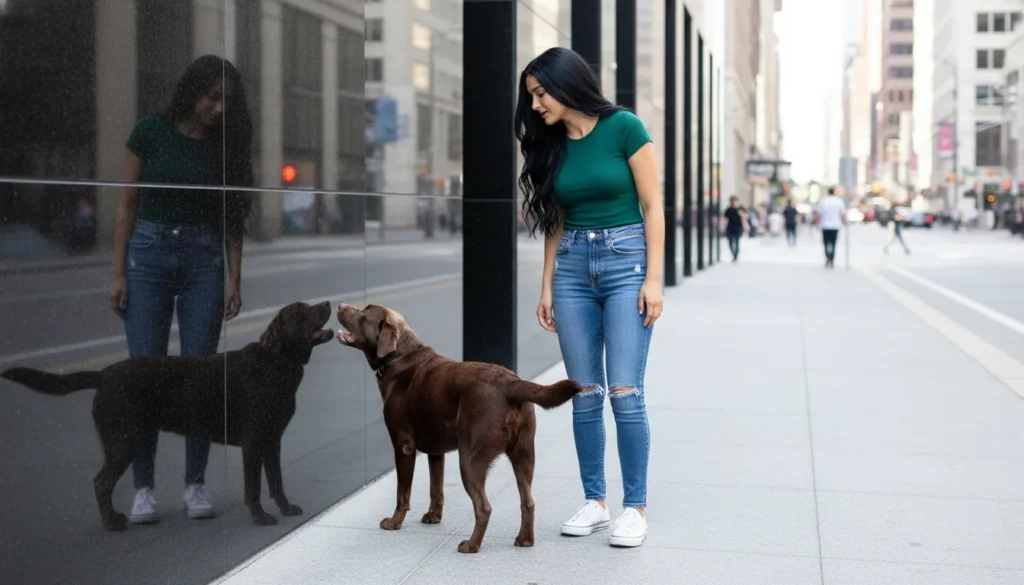
When Your Dog Barks at “Nothing”
Your dog suddenly freezes.
Their ears lock forward.
A low growl turns into sharp barking.
You look around—nothing’s there.
No stranger.
No animal.
Just a shadow on the wall. Or a reflection flickering across the floor.
To humans, it looks silly—or even amusing.
To your dog, it feels very real.
Dogs don’t bark at reflections or shadows because they’re “confused” or “not very smart.”
They bark because their brain is doing exactly what it evolved to do—detect movement, assess threat, and respond fast.
Understanding that difference changes everything.
Dogs Don’t See the World the Way Humans Do
Dogs don’t process visuals like humans.
Their brains prioritize:
- Movement over detail
- Contrast over color
- Speed over clarity
Shadows and reflections check all the boxes dogs are wired to notice.
What looks like an empty wall to you may appear to your dog as:
- Sudden movement
- Unpredictable shape shifts
- Something that doesn’t behave normally
And in nature, unpredictable movement often meant danger.
Why Reflections Confuse the Canine Brain
Reflections are especially tricky for dogs.
A reflection:
- Moves without sound
- Mimics motion without scent
- Disappears instantly
- Doesn’t respond to social cues
Dogs rely on multi-sensory confirmation.
When sight says “movement” but smell and sound say “nothing,” the brain flags it as unresolved.
Unresolved signals trigger barking.
This is why mirrors, shiny floors, windows, and TVs can all provoke reactions—especially in younger or more sensitive dogs.
Shadows Trigger the Prey–Alert System
Shadows don’t behave logically.
They:
- Stretch suddenly
- Move faster than expected
- Appear and disappear with light changes
- Don’t have clear edges
From an evolutionary standpoint, that’s exactly how predators or prey begin to appear.
Dogs don’t stop to analyze.
They react first.
This is why barking often increases:
- At dusk
- When headlights pass
- During windy days
- When sunlight shifts indoors
The trigger isn’t the shadow—it’s movement without explanation.
Puppies vs Adult Dogs: Why Age Matters
Puppies
- Still learning visual rules
- Limited experience filtering “false alarms”
- More reactive to novelty
Adult Dogs
- Better visual discrimination
- React mainly under stress or high arousal
Senior Dogs
- Vision changes
- Reduced depth perception
- Increased startle responses
What’s important isn’t whether a dog barks—but whether the behavior is increasing or persistent.
When Barking Becomes Reinforced Without You Realizing
Many dogs learn that barking at reflections “works.”
Why?
Because the reflection or shadow eventually disappears.
To the dog’s brain:
“I barked. The thing went away. Success.”
That reinforces the behavior—even though the disappearance had nothing to do with barking.
Over time, this can escalate into:
- Faster reactions
- Longer barking episodes
- Anticipatory vigilance
- Generalized reactivity
This is how a harmless quirk turns into a habit.
Emotional State Amplifies Visual Triggers
Dogs are far more reactive to shadows and reflections when they’re:
- Overtired
- Overstimulated
- Anxious
- Under-exercised
- Emotionally tense
A calm dog often ignores reflections.
A stressed dog hunts them.
That’s why the same dog may react one day and ignore the same shadow the next.
Is This Anxiety or Normal Behavior?
Not all shadow barking equals anxiety—but patterns matter.
Usually normal if:
- Short-lived
- Occasional
- Easily redirected
- Context-specific
Worth attention if:
- Occurs daily
- Escalates in intensity
- Spreads to other triggers
- Interferes with rest or play
Behavioral guidelines consistent with organizations like American Veterinary Medical Association note that repetitive reactions to non-threatening stimuli can reflect stress or sensory sensitivity rather than defiance.
Comparison Table: Normal vs Concerning Barking at Reflections
| Behavior Pattern | Likely Meaning | Recommended Action |
|---|---|---|
| Brief bark, then disengages | Normal alert | Ignore calmly |
| Repeated fixation | Learned reinforcement | Redirect early |
| Barking with pacing | Elevated arousal | Increase decompression |
| Reacts to all light movement | Sensory sensitivity | Adjust environment |
| Escalates over time | Stress-driven behavior | Professional guidance |
Common Owner Mistakes That Make It Worse
Many owners unintentionally amplify the problem.
Mistakes to avoid:
- Laughing or reacting emotionally
- Pointing out reflections
- Reassuring with anxious tone
- Yelling to stop barking
- Using punishment or corrections
All of these increase arousal—making shadows more important in your dog’s mind.
Actionable Steps to Reduce Shadow and Reflection Barking
Step 1: Manage the Environment
- Close reflective blinds
- Use matte floor coverings
- Adjust lighting angles
- Block direct mirror access if needed
Environmental control reduces triggers faster than training alone.
Step 2: Interrupt Early, Not Late
Redirect before barking escalates:
- Calm verbal cue
- Gentle movement
- Tossed treat away from trigger
- Lead to a neutral activity
Timing matters more than technique.
Step 3: Increase Daily Decompression
Dogs need time to reset their nervous systems.
Helpful outlets:
- Sniffing walks
- Food puzzles
- Chewing activities
- Calm exploration
A regulated dog reacts less to meaningless stimuli.
Step 4: Teach Neutral Observation
Instead of stopping the behavior, change the meaning.
Reward:
- Looking without barking
- Disengaging on their own
- Calm posture near triggers
This teaches the brain: “Nothing to solve here.”
Hidden Tip: Your Dog Isn’t Being “Protective”
Many owners assume shadow barking is guarding behavior.
In reality, it’s rarely about protection.
True protective responses involve:
- Directed focus
- Clear targets
- Context awareness
Shadow barking is more about uncertainty than defense.
Understanding that prevents over-correction.
Why This Matters Today
Modern homes are filled with:
- Screens
- Reflective surfaces
- Artificial lighting
- Movement patterns dogs didn’t evolve for
Dogs aren’t malfunctioning.
They’re adapting.
Helping them interpret these signals calmly reduces long-term stress and improves overall behavior.
Key Takeaways
- Dogs bark at reflections and shadows due to instinctive motion detection
- Visual ambiguity triggers alert responses
- Stress amplifies reactivity
- Reactions are often unintentionally reinforced
- Calm management and redirection work better than correction
Frequently Asked Questions
Is my dog scared of reflections?
Not exactly. They’re reacting to unresolved movement cues.
Should I correct my dog for barking at shadows?
No. Correction increases arousal and confusion.
Will my dog grow out of this behavior?
Some do—but repeated reinforcement can make it worse over time.
Can exercise help reduce shadow barking?
Yes. Mental and physical decompression lower sensitivity.
When should I seek professional help?
If the behavior escalates, generalizes, or disrupts daily life.
Conclusion: It’s Not “Nothing” to Your Dog
When your dog barks at a reflection or shadow, they’re not being dramatic.
They’re responding to a world that looks very different through canine eyes.
Once you understand that, the solution shifts from stopping the noise to helping the brain feel safe.
And calm brains bark less.
Disclaimer: This article is for general informational purposes and does not replace individualized veterinary or behavioral guidance.

Dr. Chaitanya Solanki is a licensed veterinarian with over 10 years of hands-on clinical experience in companion animal medicine. As the founder of Dr. C.M.’s Pet Clinic, he has treated thousands of dogs and cats, focusing on preventive care, behavior, nutrition, and early disease detection. His writing is evidence-based, clinically informed, and designed to help pet owners make confident, responsible care decisions.