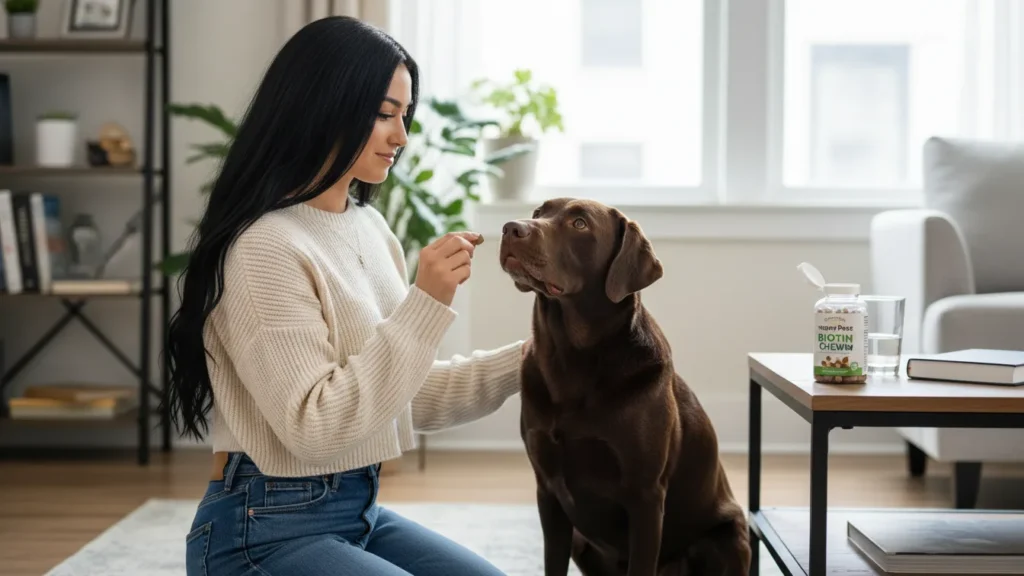
The Supplement That Sounds Like a Solution
Biotin has a reputation.
It’s marketed as the skin, coat, and nail vitamin.
It’s added to countless pet supplements.
It’s often recommended when coats look dull or skin seems unhealthy.
So when a pet develops:
- Flaky skin
- Brittle nails
- Hair thinning
Biotin feels like the obvious answer.
But here’s the reality veterinarians see daily:
Biotin helps in very specific situations — and does absolutely nothing in many others.
Understanding the difference prevents months of frustration and misplaced hope.
Why This Matters Today (Before You Add Another Supplement)
Biotin is one of the most misunderstood nutrients in pet nutrition.
Not because it’s unsafe — but because it’s often:
- Given without a real indication
- Expected to fix problems it doesn’t cause
- Stopped too early or judged incorrectly
Skin and coat issues are complex.
Biotin plays one small role in a much larger system.
Knowing when it actually matters changes everything.
What Biotin Actually Does in the Body
Biotin (vitamin B7) is a co-enzyme.
That means it helps enzymes do their jobs.
Its main roles include:
- Supporting fatty acid metabolism
- Aiding protein synthesis
- Assisting skin cell turnover
- Contributing to keratin structure (hair and nails)
Biotin does not:
- Stop allergies
- Kill infections
- Correct hormonal imbalances
- Fix inflammatory skin disease
It supports normal tissue formation, not disease reversal.
The Key Question Vets Ask First
Before recommending biotin, veterinarians ask:
“Is there actually a biotin deficiency?”
Because if the answer is no, extra biotin usually won’t change anything you can see.
And here’s the important part:
👉 True biotin deficiency in pets is uncommon, especially in those eating complete commercial diets.
When Biotin Does Help Pets
1. True or Functional Biotin Deficiency
Biotin supplementation helps when:
- Diets are incomplete or unbalanced
- Homemade diets lack proper formulation
- Absorption is impaired
In these cases, biotin can:
- Improve coat texture
- Reduce scaling
- Strengthen nails over time
These improvements appear gradually, not overnight.
2. Brittle Nails and Poor Keratin Quality
One of biotin’s clearest benefits is nail health.
Pets with:
- Cracked or splitting nails
- Poor nail growth
- Fragile claw structure
may respond positively when biotin is part of the issue.
This is structural support, not inflammation control.
3. Certain Seborrheic Conditions (Supportive Role)
In some dry, scaling skin conditions:
- Biotin can support normal skin turnover
- Results are subtle but real over time
It works best as part of a broader plan, not alone.
When Biotin Does Not Help
This is where disappointment usually happens.
1. Allergic Skin Disease
If itching is caused by:
- Food allergies
- Environmental allergens
- Fleas
Biotin will not stop the immune reaction.
The skin may still be itchy, red, and inflamed — regardless of supplementation.
2. Infections (Bacterial or Fungal)
Skin infections damage tissue directly.
Biotin cannot:
- Kill microbes
- Resolve infection
- Replace medical treatment
Infected skin must heal after the cause is treated, not before.
3. Hormonal Disorders
Conditions like thyroid disease affect:
- Hair growth cycles
- Skin thickness
- Coat quality
Biotin does not correct hormonal imbalance — so results are minimal or absent.
Comparison Table: When Biotin Works — and When It Doesn’t
| Skin / Coat Issue | Likely Biotin Benefit |
|---|---|
| True biotin deficiency | High |
| Brittle nails | Moderate |
| Dry, scaling skin (supportive) | Mild |
| Allergic itching | None |
| Skin infections | None |
| Hormonal hair loss | None |
| Omega-fatty acid imbalance | Minimal |
Real-Life Example: Same Supplement, Different Results
Dog A:
Dull coat due to unbalanced homemade diet.
Biotin added + diet corrected.
Coat improved noticeably over 6–8 weeks.
Dog B:
Severe itching from environmental allergies.
Biotin added alone.
No improvement at all.
Same vitamin.
Different root causes.
Different outcomes.
Why Biotin Often Gets Credit It Doesn’t Deserve
Here’s a subtle truth:
Biotin is frequently included in multi-ingredient supplements.
When improvement happens, owners assume:
“Biotin fixed it.”
In reality, the improvement may come from:
- Fatty acids
- Zinc
- Improved diet quality
- Reduced inflammation
Biotin was present — but not necessarily responsible.
The Timeline Mistake Owners Make
Even when biotin is appropriate, results take time.
Biotin affects:
- New skin cells
- New hair growth
- New nail formation
This means:
- Old hair doesn’t change
- Damaged nails don’t instantly strengthen
Visible improvement usually appears after several weeks, not days.
Hidden Tip: More Biotin Doesn’t Mean Better Results
Biotin is water-soluble.
Excess amounts:
- Are largely excreted
- Don’t speed up skin repair
- Don’t overcome other deficiencies
If biotin isn’t the limiting factor, adding more doesn’t help.
This is why mega-doses rarely change outcomes.
Common Biotin Supplement Mistakes
❌ Using biotin as a standalone fix
❌ Expecting itch relief
❌ Ignoring diet quality
❌ Stopping too early
❌ Assuming “no harm” equals “useful”
Biotin isn’t harmful — it’s just often irrelevant.
What Skin Problems Usually Need Instead
Many skin and coat issues respond better to:
- Fatty acid balance (omega-3 vs omega-6)
- Protein quality
- Addressing allergies
- Treating infections properly
- Overall nutritional completeness
Biotin works only when it fills a real gap.
Actionable Steps Before Using Biotin
- Review your pet’s primary diet
- Identify whether nails, skin, or hair are truly affected
- Rule out itching, infection, and allergy as causes
- Use biotin as part of a complete plan — not alone
- Commit to at least 6–8 weeks before judging results
Targeted use beats random supplementation every time.
Why This Matters Emotionally for Owners
Few things are more frustrating than:
- Doing “everything right”
- Giving supplements faithfully
- Seeing no change
Understanding biotin’s limits prevents:
- False hope
- Unnecessary expense
- Delayed proper treatment
Clarity is kinder than optimism without direction.
Key Takeaways
- Biotin helps only in specific, limited situations
- True biotin deficiency is uncommon in pets on balanced diets
- It does not treat allergies, infections, or hormonal disease
- Improvements take weeks, not days
- Biotin works best as support — not as a cure
Frequently Asked Questions
1. Is biotin safe for pets?
Yes, at appropriate doses, but safety doesn’t equal usefulness.
2. Can biotin stop itching in dogs?
No. It does not address allergic inflammation.
3. How long before biotin shows results?
Usually 4–8 weeks, if it’s relevant.
4. Should all pets take biotin?
No. Most don’t need it.
5. Is biotin better alone or in combination?
It’s more effective when part of a balanced nutritional approach.
Conclusion: Biotin Isn’t a Miracle — It’s a Tool
Biotin isn’t useless.
But it isn’t magical either.
When used for the right reason, at the right time, it can quietly support healthier skin, coat, and nails.
When used blindly, it does nothing — and delays real answers.
The key isn’t adding more supplements.
It’s understanding what the skin is actually asking for.
Disclaimer: This article is for general educational purposes only and does not replace individualized veterinary or nutritional advice. Always consult your veterinarian for persistent skin, coat, or nail concerns in pets.

Dr. Chaitanya Solanki is a licensed veterinarian with over 10 years of hands-on clinical experience in companion animal medicine. As the founder of Dr. C.M.’s Pet Clinic, he has treated thousands of dogs and cats, focusing on preventive care, behavior, nutrition, and early disease detection. His writing is evidence-based, clinically informed, and designed to help pet owners make confident, responsible care decisions.