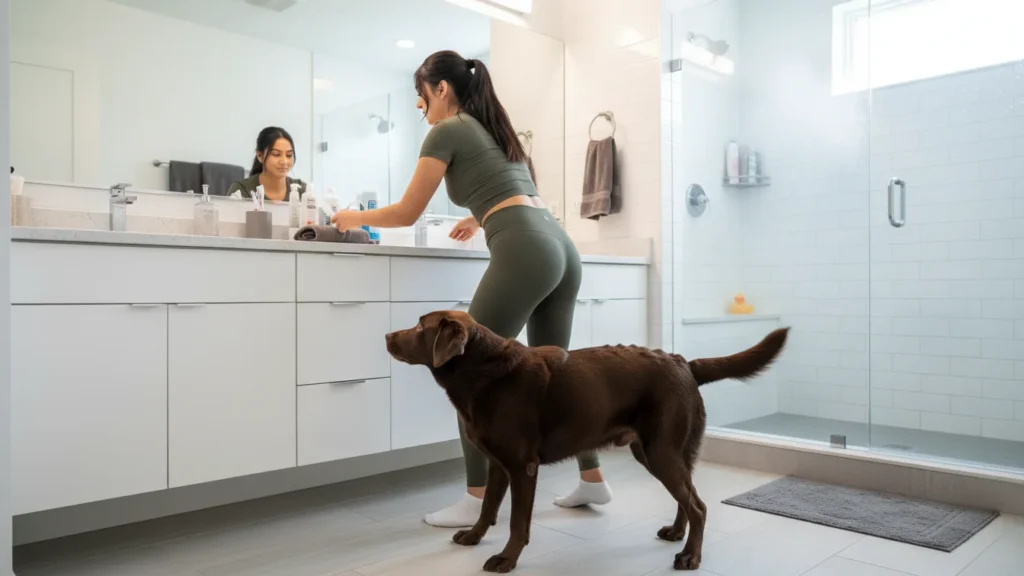
A Small Habit That Reveals Something Big About Your Dog
You close the bathroom door…
And seconds later, there they are.
A nose under the door.
A paw scratching lightly.
Or silent eyes watching you like you’ve disappeared forever.
Most dog owners laugh this off.
“He’s just clingy.”
“She’s nosy.”
“Dogs are weird.”
But here’s the truth most people never hear:
Your dog following you to the bathroom is not a joke behavior.
It’s a window into how dogs experience safety, attachment, and connection.
And once you understand why it happens, you’ll never see it the same way again.
Why This Behavior Is So Common (And So Misunderstood)
Dogs didn’t evolve to live alone.
They evolved to survive together.
In the wild, being separated from the group—even briefly—meant danger. That instinct didn’t disappear just because your dog now sleeps on a couch.
So when you walk away, especially into a closed room, your dog’s brain doesn’t think:
“They’re brushing their teeth.”
It thinks:
“My safe person just left my awareness.”
That’s the core reason this behavior exists.
But there’s more beneath the surface.
1. Dogs Are Hard-Wired to Track Their “Safe Person”
In most households, dogs emotionally attach most strongly to one person.
That person becomes:
- Their security signal
- Their stress regulator
- Their emotional reference point
When that person moves, dogs instinctively follow.
Not because of control.
Not because of dominance.
But because proximity equals safety in a dog’s nervous system.
Real-life example:
A dog may ignore other family members walking around—but instantly stand up when you leave the room.
That’s not favoritism.
That’s emotional imprinting.
2. The Bathroom Is a “Vulnerable Zone” in a Dog’s Mind
This part surprises most owners.
Dogs instinctively understand vulnerability.
In canine social groups:
- Eating
- Sleeping
- Eliminating
…are moments when protection matters most.
When you enter the bathroom, your dog doesn’t see tiles and taps.
They see:
- A confined space
- Reduced awareness
- A moment where you are distracted
So your dog does what dogs have always done:
They stand guard.
To them, following you is loyalty—not invasion.
3. Dogs Read Your Routine Better Than You Think
Dogs don’t understand clocks.
They understand patterns.
If:
- Bathroom → keys → leaving the house
- Bathroom → bedtime
- Bathroom → long absence
Your dog learns that this room often predicts separation.
So they follow—not because of the bathroom—but because of what usually comes after.
Hidden insight:
Dogs often start following more closely during:
- Schedule changes
- Owner stress
- New jobs or routines
They sense instability long before humans do.
4. Attachment Styles Exist in Dogs Too
Just like humans, dogs develop attachment styles.
| Attachment Type | How It Shows Up |
|---|---|
| Secure | Follows casually, relaxes if ignored |
| Anxious | Whines, scratches, panics if separated |
| Avoidant | Acts independent but still tracks movement |
| Hyper-attached | Needs constant physical closeness |
Bathroom following alone doesn’t mean anxiety.
But how your dog behaves during separation tells the real story.
5. Your Dog Isn’t “Being Needy” — They’re Being Social
Dogs are not solitary animals.
They don’t think:
“I’ll give them privacy.”
They think:
“We go together.”
In dog social logic:
- Together = normal
- Separation = unusual
So following you isn’t clinginess.
It’s cooperation.
Common Mistakes Owners Make (Without Realizing It)
Many well-meaning owners accidentally turn this behavior into stress.
❌ Mistake 1: Scolding or pushing the dog away
This creates confusion and insecurity.
❌ Mistake 2: Making dramatic exits
Big goodbyes teach dogs that separation is a big deal.
❌ Mistake 3: Reinforcing anxiety with excessive reassurance
Constant petting before leaving can increase dependence.
When Following Becomes a Red Flag
Bathroom following is normal.
But constant distress is not.
Watch for:
- Panic whining when doors close
- Destructive behavior during brief separations
- Refusal to eat when alone
- Excessive pacing or drooling
These can signal separation-related stress, not affection.
The difference isn’t where your dog follows you.
It’s how they cope when they can’t.
What You Should Do Instead (Healthy Responses)
✔ Encourage calm independence
- Short, neutral departures
- No emotional exits or returns
✔ Build confidence in small steps
- Practice brief separations daily
- Reward calm behavior, not following
✔ Maintain predictable routines
Dogs thrive on certainty.
✔ Give safe “anchor spots”
Beds, mats, or quiet zones where dogs can relax without tracking you.
Why This Matters More Than Most Owners Realize
A dog that follows you everywhere isn’t trying to control you.
They’re trying to stay regulated.
Understanding this:
- Prevents future anxiety issues
- Strengthens trust
- Helps dogs feel safe without constant proximity
This is how emotional security is built—not forced independence.
Key Takeaways
- Dogs follow you to the bathroom because proximity equals safety
- This behavior is rooted in evolution, not bad habits
- It often reflects trust, attachment, and routine awareness
- Healthy attachment allows following without panic
- How you respond determines whether it stays healthy
FAQs
1. Is it normal for dogs to follow owners to the bathroom?
Yes. It’s extremely common and usually reflects attachment and trust.
2. Does this mean my dog has separation anxiety?
Not necessarily. Anxiety shows distress when separated, not just following.
3. Should I stop my dog from following me?
Only if it’s paired with stress. Calm following alone doesn’t need correction.
4. Why does my dog stare at me in the bathroom?
Dogs monitor their bonded humans instinctively—it’s a protective behavior.
5. Will ignoring this behavior make it worse?
No. Calm, neutral responses help maintain emotional balance.
A Simple Truth Most Owners Never Hear
Your dog doesn’t follow you because they don’t trust the world.
They follow you because you are their world.
Understanding that responsibility—without encouraging dependence—is what great dog ownership truly looks like.
Disclaimer: This article is for general educational purposes and does not replace personalized advice from a qualified pet professional.

Dr. Chaitanya Solanki is a licensed veterinarian with over 10 years of hands-on clinical experience in companion animal medicine. As the founder of Dr. C.M.’s Pet Clinic, he has treated thousands of dogs and cats, focusing on preventive care, behavior, nutrition, and early disease detection. His writing is evidence-based, clinically informed, and designed to help pet owners make confident, responsible care decisions.