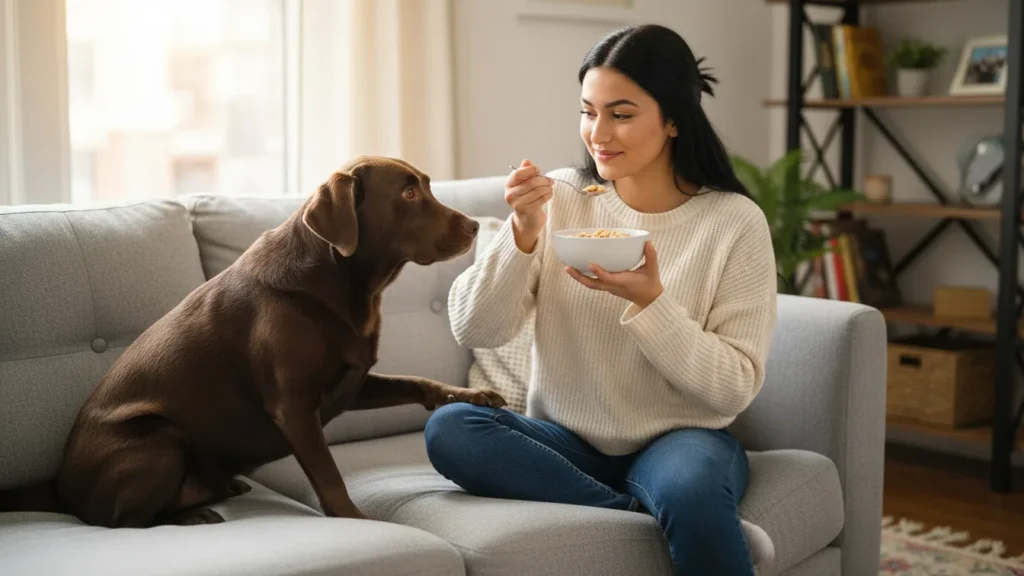
The Look Every Dog Owner Knows Too Well
You sit down to eat.
Before your first bite reaches your mouth, you feel it.
Unblinking.
Focused.
Patient… but intense.
Your dog isn’t barking.
They’re not whining.
They’re just watching.
Every bite.
Every chew.
Every swallow.
Most owners assume one thing:
“They want my food.”
Sometimes, yes.
But most of the time, that stare goes far deeper than hunger.
This Behavior Isn’t Rudeness — It’s Biology
Dogs don’t watch you eat because they lack manners.
They do it because food, social bonding, and survival are deeply intertwined in the canine brain.
Long before bowls, brands, or feeding schedules, food was:
- Shared
- Observed
- Earned through proximity and awareness
That quiet stare is a decision-making behavior, not passive begging.
Your dog is reading cues, predicting outcomes, and maintaining social connection.
1. Food Watching Is a Survival Strategy, Not Greed
In the wild, dogs and their ancestors survived by:
- Watching who had food
- Timing approach carefully
- Learning when sharing might happen
Direct confrontation was risky.
That’s why your dog doesn’t always rush or beg.
They wait and watch.
Your meal represents:
- Calories
- Opportunity
- Social hierarchy
- Environmental awareness
Their brain says:
“Pay attention. This matters.”
2. Dogs Learn Food Patterns Faster Than You Realize
Dogs are exceptional pattern learners.
They remember:
- Which meals you’ve shared food during
- Who gives treats
- What times crumbs fall
- Which foods smell strongest
Even one shared bite weeks ago can create a lasting association.
Real-life example
An owner shares chicken once during dinner.
Months later, the dog still appears every time chicken is cooked.
Not hope.
Memory.
Your dog watches because past experiences taught them that attention sometimes pays off.
3. Watching You Eat Is Also Social Bonding
In canine groups, eating isn’t just nutritional.
It’s social.
Dogs evolved to:
- Eat near trusted individuals
- Observe leaders during meals
- Stay connected during vulnerable moments
When your dog watches you eat, they’re not only focused on food.
They’re staying socially synced with you.
This is why dogs often:
- Sit near you instead of the food
- Watch your face, not your plate
- Relax once you finish eating
They weren’t just waiting.
They were sharing the moment.
4. Your Dog Is Reading Micro-Signals Constantly
They scan for:
- Hand movement
- Eye contact
- Posture shifts
- Tone changes
- Pauses between bites
Your dog knows exactly when:
- You might drop food
- You might offer food
- The meal is ending
That stare is active data collection.
It’s not passive.
It’s strategic.
Normal Food Watching vs. Problem Behavior
Not all staring is equal.
Understanding the difference prevents unnecessary correction.
Normal food watching:
- Quiet
- Patient
- Relaxed posture
- No vocalization
- Stops when meal ends
Concerning food fixation:
- Intense tension
- Whining or pacing
- Guarding behavior
- Aggression around food
- Inability to disengage
The behavior itself isn’t the issue.
The emotional state behind it is.
Comparison Table: Instinctive Watching vs. Learned Begging
| Behavior Aspect | Instinctive Watching | Learned Begging |
|---|---|---|
| Body language | Calm, still | Tense, restless |
| Vocalization | Silent | Whining, barking |
| Eye contact | Soft, steady | Intense, demanding |
| Response to ignoring | Settles | Escalates |
| Emotional state | Curious, hopeful | Frustrated, anxious |
5. Smell Makes the Experience Unavoidable
A dog’s sense of smell is tens of thousands of times stronger than yours.
When you eat:
- Aromas spread rapidly
- Fat and protein molecules linger
- Cooking smells activate feeding circuits
Your dog isn’t imagining how good your food smells.
They’re experiencing it magnified.
Ignoring food in their presence requires self-control—not indifference.
Why This Matters More Than You Think
Many owners unintentionally:
- Reinforce begging
- Create food anxiety
- Confuse dogs with mixed signals
Understanding why your dog watches helps you respond calmly instead of emotionally.
This prevents:
- Guilt feeding
- Inconsistent boundaries
- Mealtime stress
Common Mistakes Owners Make
Avoid these habits:
- ❌ Feeding from the table “just once”
- ❌ Scolding quiet watching
- ❌ Making eye contact and reacting dramatically
- ❌ Eating at inconsistent times daily
Dogs don’t understand “sometimes rules.”
They understand patterns.
Actionable Steps to Manage the Stare Gently
1. Feed Before You Eat
A fed dog watches less intensely.
2. Create a Designated Spot
Train your dog to relax on a mat during meals.
3. Avoid Eye Contact While Eating
Eye contact signals engagement.
4. Reward Calm Disengagement
Praise when your dog chooses to lie down away from the table.
5. Stay Consistent
Consistency reduces frustration faster than correction.
Real-Life Example
A family complained their dog stared nonstop during dinner.
They thought it was stubbornness.
The fix?
- Feeding the dog 15 minutes earlier
- Teaching a “place” command
- Zero table scraps
Within two weeks, the staring reduced naturally.
No punishment needed.
The Emotional Layer Most Owners Miss
Dogs don’t separate food from emotion.
Watching you eat can also mean:
- Seeking inclusion
- Reducing uncertainty
- Staying connected
- Waiting for cues
Especially in multi-dog or family households, this behavior reinforces belonging.
Why This Matters Today
As dogs live closer to humans than ever before, food becomes a shared environment—not a separate activity.
Understanding this behavior helps:
- Reduce frustration
- Improve communication
- Build trust without dependency
Sometimes, awareness is all it takes.
Key Takeaways
- Dogs watch you eat due to survival instincts, not bad manners
- Observation is safer than begging in canine behavior
- Food watching is often social, not just nutritional
- Calm watching is normal; emotional escalation is not
- Consistency shapes behavior more than correction
Frequently Asked Questions
1. Is my dog being rude by watching me eat?
No. It’s a natural, instinct-driven behavior.
2. Should I stop my dog from watching me eat?
Only if it becomes stressful. Calm watching doesn’t need correction.
3. Why does my dog stare more at certain foods?
Protein-rich or strongly scented foods trigger stronger responses.
4. Does ignoring the behavior help?
Ignoring begging helps—but calm observation should be managed, not punished.
5. Will this behavior ever stop completely?
It usually reduces with routine and boundaries, but may never disappear fully.
Conclusion: That Stare Isn’t Judgment — It’s History
When your dog watches you eat every bite, they’re not being dramatic.
They’re following instincts shaped by thousands of years of survival, learning, and social bonding.
Once you understand that, the stare feels less awkward—and a lot more meaningful.
Disclaimer: This article is for general informational purposes only and does not replace professional veterinary or behavioral advice.

Dr. Chaitanya Solanki is a licensed veterinarian with over 10 years of hands-on clinical experience in companion animal medicine. As the founder of Dr. C.M.’s Pet Clinic, he has treated thousands of dogs and cats, focusing on preventive care, behavior, nutrition, and early disease detection. His writing is evidence-based, clinically informed, and designed to help pet owners make confident, responsible care decisions.