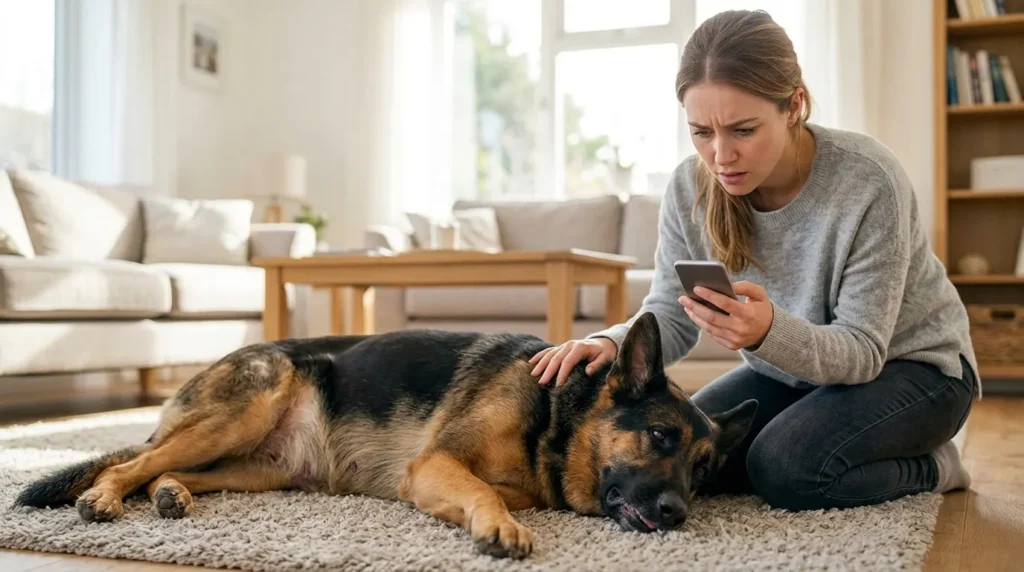
There are emergencies. And then there is bloat.
If you own a dog — especially a large, deep-chested one — there is one condition that every vet considers among the most terrifying in veterinary medicine. It’s not cancer. It’s not a car accident. It’s a stomach disorder that can go from “my dog seems off” to “we’re losing him” in under two hours.
It’s called GDV — Gastric Dilatation-Volvulus. Most people just call it bloat.
And if you’ve never heard of it, or you’ve heard of it but don’t know exactly what it looks like, this post could genuinely save your dog’s life.
What Exactly Is Bloat in Dogs?
Bloat isn’t just a gassy, uncomfortable belly. That’s a common misconception, and it’s a dangerous one.
In its most severe form, bloat occurs when a dog’s stomach fills with gas, food, or fluid and then twists on itself — cutting off blood supply to the stomach and sometimes the spleen. This is GDV, and it is always a life-threatening emergency.
Think of it like this: imagine twisting a balloon in the middle. Whatever is inside has nowhere to go. The tissue begins to die. Toxins flood the bloodstream. The heart is put under enormous pressure. The clock starts ticking — and it doesn’t stop.
Without emergency surgery, most dogs with GDV die.
Why “Minutes Matter” Isn’t Just a Phrase
Vets use the phrase “minutes matter” because it is literally true.
Studies show that survival rates for GDV drop significantly the longer the dog waits for treatment. Dogs treated within the first few hours have far better outcomes than those who arrive after the stomach tissue has begun to die.
Here’s what’s happening inside your dog’s body during a GDV episode:
- The distended stomach pushes against major blood vessels, reducing blood flow back to the heart
- Tissue in the stomach wall begins to die from lack of oxygen
- The spleen, often dragged along with the twist, can become necrotic
- Shock sets in — blood pressure drops, organs begin to fail
- The heart is directly affected, causing dangerous arrhythmias
This is not a “wait and see” situation. Ever.
The Symptoms You Cannot Afford to Miss
This is where most dog owners struggle. Bloat can look deceptively mild at first — and then escalate with terrifying speed.
Early warning signs include:
- Restlessness and inability to settle
- Repeated, unproductive retching (trying to vomit but nothing comes up)
- A visibly distended or hard abdomen, especially on the left side
- Excessive drooling or salivating
- Panting or rapid, shallow breathing
- Unusual posture — hunching over, “praying position,” or reluctance to lie down
As it progresses:
- Pale or white gums
- Weakness or collapse
- Rapid heart rate
- Signs of shock — glassy eyes, unresponsiveness
The retching is the key sign many vets emphasize. If your dog is repeatedly trying to vomit and nothing is coming up, treat it as an emergency. Don’t wait to see if it passes.
Which Dogs Are Most at Risk?
Bloat doesn’t strike randomly. There are specific risk factors, and knowing them helps you stay alert.
Breed is the biggest factor. Deep-chested, large, and giant breeds are at significantly higher risk. These include:
- Great Danes (highest risk of any breed)
- German Shepherds
- Standard Poodles
- Boxers
- Doberman Pinschers
- Irish Setters
- Weimaraners
- Saint Bernards
- Gordon Setters
Other risk factors include:
- Eating one large meal a day (vs. smaller, more frequent meals)
- Eating too fast
- Exercising vigorously right before or after eating
- Being older (middle-aged to senior dogs are at higher risk)
- Having a first-degree relative who experienced bloat
- Being male (males are statistically more at risk than females)
- Being underweight or having a fearful, anxious temperament
Small dogs can technically develop bloat too, but it’s far less common and rarely progresses to GDV.
The Common Mistakes Dog Owners Make
Knowing the mistakes is just as important as knowing what to do right.
Mistake #1: Assuming it will resolve on its own.
Bloat that involves a twisted stomach will NOT resolve on its own. It will only get worse. This is one of the few conditions where waiting is not an option.
Mistake #2: Giving Gas-X or antacids and hoping for the best.
Some people mistake GDV for simple gas and give over-the-counter remedies. These do nothing for a twisted stomach and cost precious time.
Mistake #3: Not knowing the nearest emergency vet.
In a bloat emergency, you don’t have time to Google “emergency vet near me” and read reviews. Know where your closest 24-hour emergency veterinary clinic is before you ever need it.
Mistake #4: Waiting until morning.
Bloat happens at 11 PM on a Sunday. It doesn’t check your schedule. If your dog shows symptoms, go immediately — not in the morning, not after a few hours of watching.
Mistake #5: Dismissing the symptoms in a “healthy” dog.
Bloat can strike fit, young, seemingly healthy dogs without warning. Age and good health don’t provide immunity.
What Happens at the Vet: A Quick Overview
Understanding the treatment process helps you have realistic expectations and make faster decisions.
When your dog arrives at the emergency clinic, the vet will likely:
- Stabilize — IV fluids and oxygen are started immediately to treat shock
- Decompress — A tube may be passed into the stomach to release the gas and relieve pressure
- X-ray or imaging — To confirm the diagnosis and assess the twist
- Emergency surgery — The stomach is untwisted and repositioned. Any necrotic tissue is removed. The spleen may be removed if it’s been compromised.
- Gastropexy — The stomach is surgically attached to the abdominal wall to prevent future twisting. This is often done as part of the emergency surgery or can be done preventively.
Recovery requires close monitoring, particularly in the first 24–48 hours, as heart arrhythmias can develop even after successful surgery.
Bloat vs. Simple Gas: A Quick Comparison
| Feature | Simple Gas / Mild Bloat | GDV (Life-Threatening) |
|---|---|---|
| Abdomen appearance | Slightly distended, soft | Hard, visibly bloated, tense |
| Vomiting | May vomit and feel better | Retching with nothing coming up |
| Behavior | Uncomfortable but alert | Restless, distressed, may collapse |
| Timeline | Often resolves | Rapidly worsening |
| Treatment | May resolve; vet visit advised | Emergency surgery required |
| Gum color | Normal pink | Pale, white, or grey |
When in doubt, always call your vet. There is no downside to calling — there is a massive downside to not calling.
Can Bloat Be Prevented?
Completely? No. But you can significantly reduce the risk.
Feed smaller, more frequent meals. Instead of one large meal, split daily food into two or three portions.
Slow down eating. Use a slow-feeder bowl, a lick mat, or a puzzle feeder to prevent gulping. Fast eating is one of the most consistent risk factors.
Restrict exercise before and after meals. A general guideline is to wait at least an hour after eating before vigorous exercise. Avoid feeding right after intense activity too.
Avoid raised food bowls (controversial, but note this). For years, raised bowls were recommended — newer research suggests they may actually increase bloat risk in large breeds. Discuss with your vet.
Consider preventive gastropexy. If you own a high-risk breed, talk to your vet about a prophylactic gastropexy — a procedure to tack the stomach to the abdominal wall before bloat ever occurs. It’s often done during spaying or neutering. It doesn’t prevent gas buildup but does prevent the deadly twist.
A Real-Life Scenario That Puts It in Perspective
Imagine this: it’s a Wednesday evening. Your Great Dane, who just finished dinner an hour ago, starts pacing. You notice he’s tried to vomit twice with nothing coming up. His belly looks a little rounder than usual. He can’t seem to get comfortable.
You Google “dog acting strange after dinner.”
Thirty minutes pass. Now he’s drooling, his gums look pale, and he’s trembling.
You rush to the emergency vet. They tell you he has GDV — his stomach has twisted. He goes straight into surgery.
He survives. Barely.
The vet tells you: “Another hour and we couldn’t have saved him.”
This story plays out in emergency vet clinics around the world every single day. The dog owners who act fast are the ones who get to bring their dogs home.
Key Takeaways
- Bloat (GDV) is a life-threatening emergency where the stomach fills with gas and twists
- Key symptoms: unproductive retching, hard/distended abdomen, restlessness, pale gums
- Large, deep-chested breeds are most at risk — especially Great Danes, German Shepherds, and Standard Poodles
- Do NOT wait to see if symptoms resolve — go to an emergency vet immediately
- Preventive steps include smaller meals, slow feeders, and discussing gastropexy with your vet
- Know your nearest 24-hour emergency vet clinic now, before you need it
Frequently Asked Questions
Q1: Can a dog survive bloat without surgery? Simple gastric dilatation (stomach distension without twisting) can sometimes be treated without surgery through decompression and monitoring. However, GDV — where the stomach has twisted — almost always requires emergency surgery to survive. There is no way to confirm which type it is without veterinary assessment.
Q2: How quickly does bloat progress in dogs? GDV can progress from early symptoms to life-threatening shock within two to six hours. Some cases move even faster. This is why any suspected bloat should be treated as an immediate emergency.
Q3: Is bloat painful for dogs? Yes. Bloat is extremely painful. The distension and twisting cause intense abdominal pain, which is why affected dogs appear so distressed and restless. The pain, combined with cardiovascular stress, makes rapid treatment essential for both survival and humane care.
Q4: Can bloat happen in small dogs? Yes, though it’s far less common. Small dogs can develop gastric dilatation but rarely progress to GDV with a stomach twist. However, any dog showing signs of bloat should be evaluated by a vet regardless of size.
Q5: What is the survival rate for dogs with GDV? With prompt surgery, survival rates range from around 80–90% for dogs that haven’t developed severe complications. Survival rates drop significantly when surgery is delayed, when stomach tissue is necrotic, or when cardiac complications arise. Early action is the single biggest factor in outcome.
Final Thoughts
Bloat is one of those conditions that every dog owner hopes they never encounter — but every dog owner needs to understand.
You don’t need to live in fear. You just need to be informed.
Know the signs. Know your risk factors. Know your nearest emergency vet. And if something ever looks wrong with your dog’s belly, never wait it out.
The dogs that survive bloat don’t survive because they were lucky. They survive because someone recognized the signs and moved fast.
That someone can be you.

Dr. Chaitanya Solanki is a licensed veterinarian with over 10 years of hands-on clinical experience in companion animal medicine. As the founder of Dr. C.M.’s Pet Clinic, he has treated thousands of dogs and cats, focusing on preventive care, behavior, nutrition, and early disease detection. His writing is evidence-based, clinically informed, and designed to help pet owners make confident, responsible care decisions.