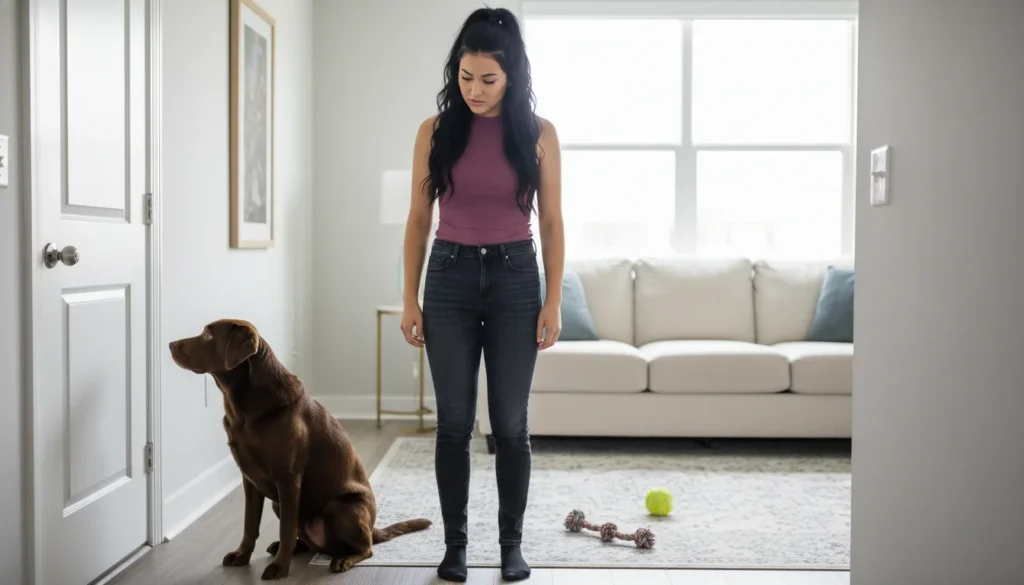
You’re relaxing at home.
Maybe you’re on the couch.
Maybe you’re working quietly.
And your dog is… not asleep.
Not playing.
Not even looking at you.
Instead, they’re sitting near the door.
Staring.
Listening.
As if they’re waiting for something that never comes.
Many dog owners notice this behavior and wonder:
“Why does my dog keep watching the door when I’m right here?”
Are they anxious?
Are they bored?
Are they protecting the house?
The answer is surprisingly deep—and often emotional.
Because when a dog watches the door, they aren’t just staring at wood and hinges…
They’re watching the boundary between safety and the outside world.
Let’s explore the hidden psychology, instincts, and real reasons dogs do this—so you can understand what your dog may be feeling.
Dogs See Doors Differently Than Humans Do
To us, a door is just a door.
To a dog, a door is a powerful symbol.
It represents:
- The outside world
- Unknown movement
- Strange scents
- Visitors
- Potential threats
- The moment you leave
A door is not an object.
It’s an event waiting to happen.
So when your dog watches it…
They may be monitoring possibility.
The Instinct to Guard the Pack’s Territory
Dogs are descendants of wolves and social pack animals.
In natural settings, the pack survives by being aware of what approaches.
Even though your dog lives in a modern home…
Their brain still carries ancient instincts:
- Watch entrances
- Stay alert to changes
- Notice approaching sounds
The door is the main entry point to their territory.
So sitting near it can be a quiet protective role:
“This is my space. I’m paying attention.”
This doesn’t mean aggression.
It often means responsibility.
Your Dog May Be Waiting for Something Familiar
Sometimes, door-watching is less about danger…
And more about anticipation.
Dogs are deeply routine-driven.
If the door usually signals:
- A walk
- A delivery
- A family member arriving
- Playtime outside
They may sit there because they’re expecting the next chapter of the day.
Dogs don’t track time with clocks.
They track life through patterns.
The door is part of the pattern.
They’re Listening to a World You Can’t Hear
Dogs have far sharper hearing than humans.
They can detect:
- Footsteps down the street
- A car door closing outside
- Keys jingling from far away
- Neighbor movement
Many times, your dog is reacting to sounds you don’t even notice.
So when they stare at the door…
They may already know something is happening outside.
To you, it’s silence.
To them, it’s information.
Door-Watching Can Be an Emotional Attachment Behavior
Here’s something many people don’t realize:
Dogs watch doors not only because of instinct…
But because of love.
Your dog may associate the door with separation.
Even if you’re home right now…
The door is still the place where you sometimes disappear.
Some dogs stay aware of it because it represents:
- You leaving
- You returning
- Togetherness being interrupted
Door-watching can be an emotional vigilance:
“I’m keeping track… just in case.”
Real-Life Example: The Dog Who Always Sits by the Entrance
Many owners describe this:
“My dog follows me everywhere… but always chooses the door spot.”
This often happens in dogs who feel naturally responsible.
They may want to:
- Keep watch
- Stay ready
- Be the first to greet
- Be the first to alert
It’s their version of being involved.
Not distant.
Just positioned.
The Door Is a Scent Hotspot
Dogs live in a world of smell.
And doors are full of scent activity.
Every time the door opens, it brings in:
- Outdoor air
- Other animals’ scent trails
- Human visitors’ smells
- New environmental information
Your dog may watch the door because they’re also smelling it constantly.
To them, it’s like checking the news.
“What’s changed outside?”
Some Dogs Watch the Door Due to Mild Anxiety
Not all door-watching is purely instinct or curiosity.
In some dogs, it can signal unease.
Signs it may be anxiety-based include:
- Constant pacing near the door
- Whining or trembling
- Unable to relax
- Overreacting to every sound
This is more common in:
- Rescue dogs
- Dogs with separation sensitivity
- Dogs adjusting to new homes
In these cases, door-watching is less “guarding”…
And more “worrying.”
Door-Watching as a Job: Working Breed Behavior
Certain breeds are especially likely to monitor doors:
- German Shepherds
- Border Collies
- Dobermans
- Australian Shepherds
These breeds were developed for awareness and protection roles.
They often assign themselves tasks like:
- Watching windows
- Monitoring movement
- Guarding entrances
For them, door-watching can be deeply satisfying.
It’s a self-appointed job.
Hidden Tip: Your Dog Might Be Picking Up on Your Stress
Dogs are extremely sensitive to human emotion.
If you’ve been anxious, tense, or unsettled…
Your dog may become more watchful.
They don’t understand bills or emails.
But they understand nervous energy.
Door-watching may increase when they sense:
“Something feels off.”
They respond with alertness.
Not because the door is the problem…
But because they are tuned into you.
Mistakes Owners Make When Dogs Watch the Door
1. Assuming It’s Always a Problem
Sometimes, it’s just normal canine awareness.
Not every behavior needs correction.
2. Accidentally Reinforcing Hypervigilance
If your dog barks at the door…
And you immediately rush over anxiously…
They learn:
“The door really is a big deal.”
Calm response teaches calm.
3. Not Providing Enough Mental Stimulation
A bored dog often becomes a watchful dog.
If your dog has little enrichment, the door becomes entertainment.
Actionable Steps: What to Do If Your Dog Watches the Door Constantly
Here are gentle, practical solutions.
✅ Provide Alternative Resting Spaces
Give your dog comfortable beds away from the entrance.
Reward relaxing in those places.
✅ Increase Enrichment During the Day
Try:
- Snuffle mats
- Puzzle feeders
- Chew activities
- Short training games
Mental work reduces watchful boredom.
✅ Teach a “Place” Cue
Train your dog to settle calmly in a designated spot.
This helps if door-watching becomes obsessive.
✅ Stay Calm During Door Noises
If someone passes outside, model calm behavior.
Dogs take cues from your response.
✅ Check for Stress Signals
If door-watching comes with trembling, whining, or panic…
A veterinarian or qualified behaviorist can help guide support safely.
Why This Matters Today (Evergreen Insight)
Modern dogs live indoors…
But their brains still carry outdoor instincts.
A door is the meeting point between:
- The safe home world
- The unpredictable outside world
Understanding why your dog watches the door helps you see them clearly:
Not as “weird”…
But as aware.
Protective.
Emotionally connected.
And always trying to make sense of their environment.
The Beautiful Truth
When your dog watches the door…
They may not be waiting for danger.
They may not even be waiting for someone.
They may simply be doing what dogs have always done:
Staying aware.
Staying ready.
Staying connected to the pack.
It’s one of the quiet ways they say:
“This is my home… and you are my world.”

Dr. Chaitanya Solanki is a licensed veterinarian with over 10 years of hands-on clinical experience in companion animal medicine. As the founder of Dr. C.M.’s Pet Clinic, he has treated thousands of dogs and cats, focusing on preventive care, behavior, nutrition, and early disease detection. His writing is evidence-based, clinically informed, and designed to help pet owners make confident, responsible care decisions.